
Monday, 5 May 2014

Atilogu Dancers. Ulli Beier 1959
Atilogwu is a traditionally spirited youth dance from the Igbo ethnic group of Nigeria that focuses on vigorous body movement and often includes acrobatics. In the Igbo language, the word itself “Atilogwu” translates into “has magic—as in sorcery/ witchcraft—been put into it?”
The name stems from rumors that bewitchment or magic potions had to be involved if the children of the village could perform so exuberantly and energetically, while making it look so effortless. The tempo of the dance matches the tempo of the music, which is dependent on the beat of the drum and “ogene,” a metal gong instrument.


Today in History - 5th May 2010 President Yar'Adua dies
Umaru Musa Yar'Adua was the President of Nigeria and the 13th Head of State (From 29 May 2007 till death ) He had previously served as governor of Katsina State in northern Nigeria from 29 May 1999 to 28 May 2007. In 2009, Yar'Adua left for Saudi Arabia to receive treatment for pericarditis. He returned to Nigeria in 2010, where he died on 5 May.

Sunday, 4 May 2014
Idia
Queen Mother of Esigie, the ruler of Benin Kingdom in the early 1500s.
Esigie created the political title Iyoba to include her in his administration . Idia has been described as a valiant warrior. She is credited with Esigie's successful conquest of the neighbouring Igala Kingdom. Her son built her a palace outside Benin and gave her territory over which to rule. In Bini oral tradition, Idia has several praise names, such as "Idia ne ekonorhue" meaning "Idia, the womb of Orohue"
This Ivory carving of her face was adopted in 1977 as the emblem of the World Bank and African Festival of Arts and Culture
FOUR COPIES of the carving were taken from the private residence of Oba Ovoranmwen in 1897 by the British military force that invaded the capital of the Empire, Edo (now Benin City in Nigeria) during the "punitive expedition" and memories of the humiliation that the King suffered at the hands of the British (he was deposed and banished to Calabar) still evokes bitterness.
The carving is still the centrepiece of the African exhibition at the British Museum which attracts thousands of visitors each year.
One of the other three copies of the carving is now in the Metropolitan Museum in New York, another is in a private collection in California and the fourth is in the hands of an anonymous British collector.
When the Nigerian military government at the time (headed by Olusegun Obasanjo), made a formal request for the carving's return . The British government bluntly refused, their reason..... The head of the conservation department at the Museum was of the opinion that "because of the condition of the object, it was unsafe to travel. The surface of the mask was cracked and it was thought that a sudden change in environment, from a cold climate to a suddenly hot one could worsen its state."

Thursday, 1 May 2014
Thank you note written by Flora Shaw. February 1900
Flora Shaw was a British journalist. She is credited with having coined the name "Nigeria" (even though it had been in use way before) She married Sir Frederick Lugard in 1902 he was the first Governor-General of Nigeria.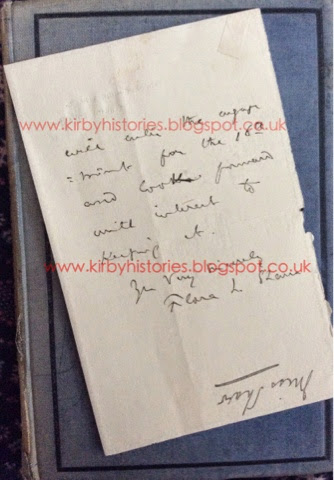
Wednesday, 30 April 2014
Ulli Beier at an exhibition of works by African authors 1959
Ulli Beier, was a formidable proponent of modern African art and literature at a time when it received scant attention from the Western mainstream.
For most of his career Beier was a university lecturer, but unlike most academics he participated in and actively instigated many of the developments he wrote about.
His attempts to promote both traditional and modern African arts led to the creation of Black Orpheus, the first African literary magazine in English, which he co-founded in 1957 and the Mbari Club, a watering hole for writers and artists in the Nigerian university city of Ibadan, which convened in 1961 with the involvement of Africa’s two literary giants: the Nobel Prize-winning dramatist Wole Soyinka and Chinua Achebe, author of the celebrated novel Things Fall Apart.
The Mbari Club became synonymous with the optimism and creative exuberance of Africa’s post-independence era. Fela Kuti made his debut as bandleader there, and it became a magnet for artists and writers from all over Africa, America and the Caribbean.

Subscribe to:
Posts (Atom)